Two thousand years is a really, really, really long time. My great-grandmother lived 109 years, the definition of a long time.  She was born while Lincoln was campaigning for office and died while Nixon was campaigning for office. Shakespeare was born 455 years ago, which is a really long time ago. (I anticipate a big celebration 45 years from now.) We have to go back 764 years from baby Shakespeare, a really, really long time ago, to find Charlemagne being crowed the first Holy Roman Emperor, with crown of many jewels. But from there we must travel another 764 years into the past to get where we last heard of our ruby, as Nicodemus describes it in the possession of a roman soldier on his way home to Cappadocia, in what is now central Turkey. Even a large ruby is a pretty small thing, easily lost in the haystack of time.
Most stuff doesn’t last long. Most things we make and own vanish quickly into time. In a hundred years, very few of our possessions will have enough meaning that our descendants will still have them. Imagine the difficulty in tracking a single object not over a lifetime, but over two thousand years of history. It requires inordinate luck.
Charlemagne was king of the Franks (present day France and Germany) and the Lombards (northern Italy) when he was invited by Pope Leo III to Christmas Mass, where he was given the ultimate Christmas present, a crown formed of gold plates pinned together and adorned with jewels. Pope Leo declared Charles to be Emperor of all of what once had been the Roman Empire (which was news, when they heard, to the Empire of Byzantium). Our interest in the coronation is not the fact that it would eventually lead to the fracturing of the Church, but in that famous crown.
The current crown, which sits in the Imperial Treasury in Vienna, was likely made from the original Crown of Charlemagne, and many of the jewels may date from that time. But one, known as the orphan, has been missing for a long time. In 1250, Albert the Great described it. “The orphan is a jewel in the crown of the Roman emperor. Because the like of it has never been seen elsewhere it is called the “orphan”. It has the color of wine, of delicate red wine and it is as if the dazzling, white of snow penetrates the bright wine red and yet it remains dormant in this redness. The gem shines powerfully and it is said that it once even shone at night, but not in our time, but it is said to preserve the honour of the empire.”
If that was the only clue we had, it would be hard to say the stone missing from Charlemagne’s crown was the Christus ruby. Fortunately, we also have the detective work of an obscure professor of archaeology, who wrote a small, mostly forgotten book describing the curious world of religious relics. In Dr. Dufee’s book there is a small passage describing what sounds like our ruby. Incredibly, the Christus ruby, which disappears after Charlemagne’s coronation, reappears in the form of a gold ring, still associated with the crown jewels of the Holy Roman Emperor. I have copied the excerpt from the book into this post; you can read it for yourself.
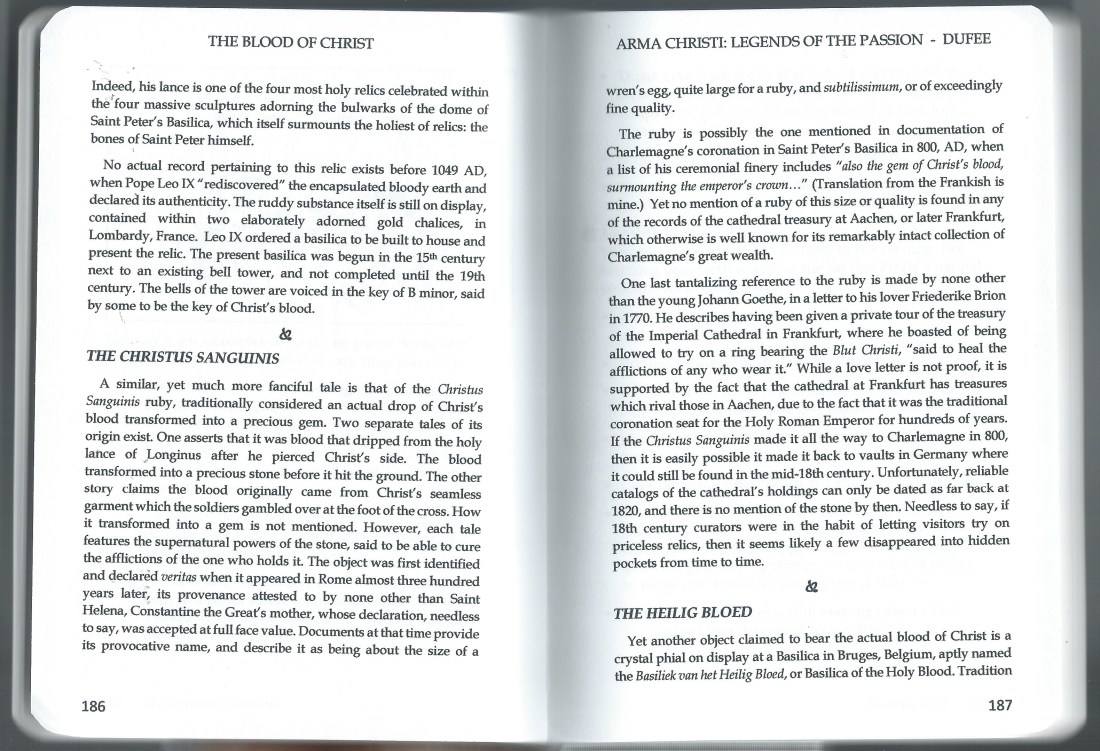
How the ruby got from the centurion Longinus to Charlemagne is a study in speculation, and is the subject of my next post. But where it went after 1770, and if it indeed ended up in the possession of a retired Great Lakes schooner captain in the nineteenth century, and where it went from there – well, that’s what we intend to find out.

 LHOSAWORLD